

I still remember the first time a “digital PR win” actually moved a client’s revenue number, not just their vanity metrics. It was a small home-goods brand, three years ago, and one data-driven story built around a survey nobody had ever bothered to run landed coverage on a handful of regional news sites. Traffic spiked for a week. Then something more interesting happened: six months later, the client’s organic rankings for their two most competitive keywords had climbed past a competitor with triple their ad budget. That’s when digital PR stopped being a buzzword to me and started being a line item worth defending in a budget meeting.
This guide covers what digital PR actually is, how it works day to day, the strategies and campaign types that get results, what it costs, and how to measure whether it’s working. No fluff, no recycled definitions just what you need to plan, run, or hire out a digital PR program with your eyes open.
What Is Digital PR?
Digital PR is the practice of earning media coverage, backlinks, and brand mentions online through relationships with journalists, publishers, and content creators rather than through paid placements. Where traditional PR chased print headlines and TV segments, digital PR (sometimes written as digitalpr, digital public relations, or dijital pr in international searches) is built around online publications, digital-first outlets, and the SEO value that a link from a trusted site carries.
At its core, it’s still PR: you’re shaping how a brand is perceived by a public audience. What’s different is the mechanism. A digital PR campaign might centre on original research, a striking piece of data journalism, an expert commentary offer, or a genuinely useful tool anything a journalist would want to write about on its own merits. The “digital” part isn’t cosmetic. It changes what counts as success (a followed backlink matters as much as a mention), who you’re pitching (freelancers and niche bloggers as often as staff reporters), and how fast the whole cycle moves.
One thing worth being upfront about: digital PR isn’t a replacement for SEO, content marketing, or paid media. It’s a channel that, done well, reinforces all three.
What Are the Benefits of Digital PR?
The honest answer is that digital PR earns its budget slowly, then all at once. A single placement rarely changes anything. A sustained program, run over a year or more, tends to compound.
Increased Brand Visibility
Coverage on outlets your audience already trusts puts your name in front of people who were never going to see your ads. In my experience, this matters most for brands entering a crowded category; visibility from a third party carries weight that a company’s own marketing simply can’t buy.
SEO & Organic Traffic Gains
Backlinks from authoritative, relevant sites remain one of the strongest ranking signals Google uses, and digital PR is one of the few scalable ways to earn them naturally rather than build them artificially. The traffic lift from a single article is often modest; the cumulative lift from dozens of them, over months, is where most of the value sits.
Authority & Trust Building
Being cited by respected publications signals to both readers and search engines that a brand is a credible source in its field. This is the E-E-A-T logic search engines increasingly rely on; third-party validation is harder to fake than on-site claims.
Referral Traffic & Backlinks
Beyond SEO, coverage sends real people to your site readers who click through mid-article, not just search-engine crawlers. That referral traffic tends to convert differently than paid traffic, since it arrives with a journalist’s implicit endorsement already attached.
What Is the Difference Between PR and Digital PR?
They share a goal of shaping public perception, but the tactics, timelines, and measurement diverge in practical ways.
Traditional PR vs Digital PR
Traditional PR leans on press releases distributed to newsrooms, print and broadcast relationships, and coverage that’s hard to attribute directly to business outcomes. Digital PR operates on shorter cycles, targets online-first and hybrid publications, and produces trackable assets: links, referral traffic, and measurable ranking shifts. Traditional PR still matters for brand reputation and crisis response; digital PR is where most of today’s SEO-linked PR budget goes.
| Traditional PR | Digital PR | |
| Primary channels | Print, TV, radio | Online publications, blogs, digital-first media |
| Core output | Media mentions, brand sentiment | Backlinks, mentions, referral traffic |
| Measurability | Largely qualitative | Quantifiable (links, traffic, rankings) |
| Typical cycle | Weeks to months | Days to weeks |
Digital PR vs Online PR
These terms get used almost interchangeably, and honestly, most practitioners don’t lose sleep over the distinction. Where a line exists, “online PR” is sometimes used more broadly to include social media management and online reputation monitoring, while “digital PR” specifically implies an SEO-and-link-focused approach to earned coverage. In practice, agencies and job listings rarely draw this line consistently, so don’t treat it as a meaningful category split.
How Does Digital PR Work?
A digital PR campaign is a process, not a single pitch. Skip a step and the whole thing tends to underperform, no matter how good the story angle is.
Research & Audience Identification
Before any outreach happens, you need to know who you’re trying to reach and, just as importantly, who covers that audience. This means mapping out target publications, understanding what a specific journalist has written recently, and identifying the gap between what’s already been covered and what hasn’t.
Creating a Newsworthy Story
This is the part most campaigns get wrong. A press release about a product launch is not newsworthy to an independent journalist; it’s advertising. What works is original data, a contrarian expert take, a timely angle on a trending topic, or a genuinely useful resource. If you wouldn’t read the pitch yourself, a journalist won’t either.
Building a Media List
A media list is a curated set of journalists, editors, and freelancers who plausibly cover your topic, built from bylines, beat pages, and prior coverage, not a scraped database of anyone with “media” in their job title. A tight list of thirty relevant contacts consistently outperforms a scattergun blast to five hundred.
Outreach to Journalists
The pitch itself needs to lead with the story, not the brand. Journalists are triaging dozens of emails an hour; a subject line and opening sentence have to earn the next ten seconds of attention. Personalisation referencing a specific piece they wrote still moves the needle more than any template trick.
Distribution & Earning Coverage
Once a journalist bites, the goal shifts to making their job easy: fast follow-up, clear data, quotable lines, supporting visuals if relevant. Some coverage arrives within hours of a good pitch; other stories take weeks of follow-up before they land, if they land at all.
Measuring Results
The campaign isn’t done when the article publishes. Tracking which links were followed versus nofollowed, what referral traffic each placement drove, and how domain authority shifts over the following months is what turns a “nice mention” into a program you can defend to a CFO.
Types of Digital PR
Not every campaign looks the same, and most mature programs run several of these types in parallel rather than picking just one.
Media Outreach
Direct pitching to journalists and editors to secure coverage, mentions, or interviews is the foundational activity underneath most other digital PR tactics.
Digital Press Releases
Announcements distributed online for product launches, funding news, or major company updates. Less effective on their own than they were a decade ago, but still useful for time-sensitive news that needs broad, fast distribution.
Influencer Relations
Building relationships with online creators and niche influencers whose audiences overlap with a brand’s target market, often blurring into affiliate and sponsored-content territory depending on the arrangement.
Social Media PR
Managing brand narrative, engagement, and crisis response across social platforms, increasingly a first line of defence (or offence) alongside earned media.
Blogger Outreach
Pitching independent bloggers and niche site owners, who often have smaller but highly engaged, topically focused audiences that mainstream outlets can’t replicate.
Thought Leadership
Positioning executives or subject-matter experts as go-to commentators through bylined articles, expert-source platforms, and speaking opportunities.
Newsjacking
Attaching a brand’s expertise or data to a trending news story while it’s still current a tactic that rewards speed above almost everything else.
Data-Driven PR
Building campaigns around original surveys, proprietary data sets, or analysis of public data is the format most likely to earn coverage on its own merit rather than a company’s say-so.
Content-Led Digital PR
Producing standalone assets interactive tools, in-depth studies, visual explainers designed specifically to be linked to and covered, rather than pitched around an existing product.
Online Reputation Management
Monitoring and shaping how a brand appears across search results, review sites, and social mentions, often working reactively alongside proactive campaigns.
Digital PR Strategy
What Is a Digital PR Strategy?
A digital PR strategy is the documented plan connecting business goals to specific campaign types, target publications, and success metrics the difference between running isolated campaigns and building a program that compounds over time.
How to Create a Digital PR Strategy
Start with the business outcome you actually need: rankings for specific terms, brand awareness in a new market, authority in a niche, and work backward. Audit existing coverage and backlink profiles, identify content gaps competitors haven’t filled, then map campaign ideas to the publications most likely to run them. I’ve seen more strategies fail from skipping this audit step than from any weakness in the actual pitching.
Choosing the Right PR Channels
Not every publication is worth pursuing. A link from a small, highly relevant industry blog can outperform a mention buried in a large but topically irrelevant outlet, both for SEO and for the audience it actually reaches. Prioritise relevance over raw domain authority.
Measuring Campaign Success
Define success metrics before launch, not after: number of placements, followed links secured, referral traffic, and ranking movement on target keywords. Agreeing on these upfront avoids the awkward retrofit of “well, brand awareness is hard to measure” after a campaign underdelivers on links.
What Are Examples of Digital PR? (Campaigns)
What Is a Digital PR Campaign?
A digital PR campaign is a time-bound effort built around a single story, data set, or asset, designed to earn coverage, links, and mentions within a defined period, distinct from always-on activities like ongoing media relationships or reputation monitoring.
Types of Digital PR Campaigns
Common formats include original research and surveys, expert commentary roundups, interactive data visualisations, awards or rankings (“best of” lists brands create themselves), and reactive newsjacking tied to a live story. Each format suits different budgets and timelines; a survey campaign might take six weeks to plan and execute properly, while a newsjacking response needs to go out within hours.
Successful Digital PR Campaign Ideas
The campaigns that consistently earn coverage share a pattern: they answer a question a journalist’s audience is already asking, using data or an angle nobody else has. A finance brand analysing which UK cities have the fastest-growing average salaries will outperform a press release about that brand’s new savings account, every time, because the first is a story and the second is an ad. The strongest ideas often come from mining a brand’s own internal data transaction trends, search data, customer surveys for something genuinely surprising.
Digital PR and SEO
What Is PR in SEO?
In an SEO context, PR refers to the practice of earning backlinks and brand mentions through media coverage rather than through paid or manipulative link-building tactics. Link acquisition is often the primary KPI, even though the campaign itself is built around a genuine story.
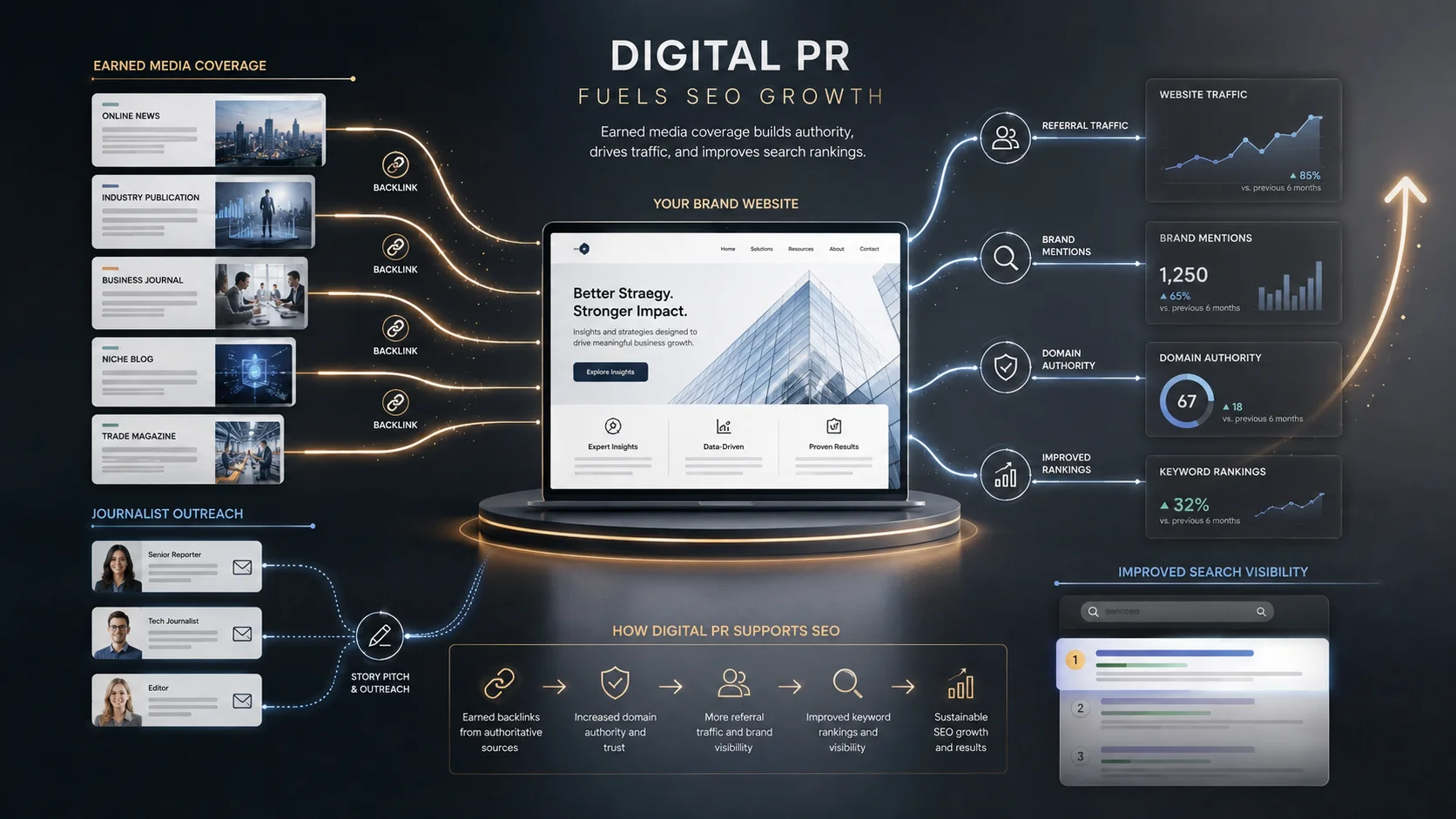
How Digital PR Supports SEO
Backlinks from relevant, authoritative sites remain a core ranking factor, and digital PR is one of the more scalable, policy-compliant ways to earn them. Beyond links, coverage also generates branded search volume and direct traffic signals that support rankings indirectly, alongside the direct link equity.
Digital PR for Link Building
How digital PR earns backlinks. A journalist links to a source, a data page, or an original piece of research as part of writing their story; the link is a byproduct of the coverage, not something negotiated separately.
Digital PR vs traditional link building. Traditional link building often involves direct outreach requesting a link be added to existing content. Digital PR earns the link as part of new coverage, which search engines generally treat as a stronger, more natural signal.
How journalists and publishers create SEO value. Beyond the link itself, publisher domain authority, topical relevance, and the surrounding editorial context all influence how much SEO value a given placement passes on, which is why a smaller, on-topic outlet can outperform a larger, off-topic one.
Digital PR and Social Media
What Is PR in Social Media?
PR in social media covers how a brand manages its public narrative, engages with audiences, and responds to both praise and criticism across social platforms a role that increasingly overlaps with, but isn’t identical to, social media marketing.
Digital PR vs Social Media PR
Digital PR is primarily focused on earning third-party media coverage and backlinks; social media PR is about managing a brand’s own channels and its direct relationship with its audience. They intersect constantly; a piece of digital PR coverage is often amplified through social channels, but they’re managed with different goals and, usually, different metrics.
Using Social Media to Amplify PR Campaigns
Sharing earned coverage on brand social channels extends its reach well past the original publication’s audience, and can prompt further pickup from other journalists who spot the story circulating. It’s a low-cost extension step that a surprising number of teams skip.
Digital PR and Digital Marketing
What Is PR in Digital Marketing?
Within a digital marketing mix, PR is the earned-media layer of coverage and links a brand doesn’t pay for directly, sitting alongside paid, owned, and organic social channels.
Digital PR vs Digital Marketing
Digital marketing is the umbrella term covering paid ads, email, SEO, content, and social, with digital PR as one channel underneath it. The distinction that matters practically: digital PR results are earned, not bought, which is exactly what gives them the credibility and SEO value that paid channels can’t replicate.
Integrating Digital PR Into a Marketing Strategy
Digital PR performs best when it isn’t siloed. Coverage secured by a PR team should feed into content marketing (topic ideas), SEO (link targets), and social media (amplification); treating it as a standalone activity tends to waste most of its downstream value.
Digital PR Services & Agencies
What Do Digital PR Services Include?
Most digital PR service packages cover strategy development, campaign ideation, content and asset creation, media list building, journalist outreach, and reporting. Some agencies also handle influencer relations or reputation management as add-ons rather than core services.
What Does a Digital PR Agency Do?
A digital PR agency runs the end-to-end process on a client’s behalf: researching angles, building the story or data asset, pitching journalists, securing and tracking coverage, and reporting on links and traffic. Good agencies also advise on which campaigns are realistic given a brand’s industry and existing media relationships; not every business has an equally “pitchable” story every month.
Digital PR Company vs Agency vs Firm
These terms are used almost interchangeably in the market. Where distinctions do appear, “firm” sometimes implies a more traditional, relationship-based PR shop, while “agency” is more commonly used for teams built specifically around SEO-linked digital PR. Don’t rely on the label alone; check the actual case studies and reporting they provide.
How to Choose a Digital PR Agency
Ask for case studies with real, verifiable placements and links, not just logos of outlets they’ve “worked with.” Check whether their reporting distinguishes followed from nofollowed links; an agency that doesn’t make this distinction either doesn’t understand SEO or is hoping you won’t ask. Also worth checking: how they generate story ideas, since agencies that recycle the same three campaign formats across every client tend to see diminishing returns fast.
How Much Does Digital PR Cost?
Digital PR Agency Pricing
Pricing varies widely by market and scope, but retainer-based digital PR programs commonly range from roughly $2,000–$3,000 a month for smaller, focused campaigns up to $10,000+ a month for larger, multi-campaign programs at established agencies. Project-based campaigns (a single data study, for instance) are often priced separately from ongoing retainers.
Factors Affecting Digital PR Costs
Cost scales with campaign complexity (an original survey with custom data visualization costs more than a reactive newsjacking pitch), agency reputation and media relationships, target market competitiveness, and reporting depth. A niche B2B brand with a small but well-connected agency may spend less than a competitive consumer brand chasing national coverage.
Digital PR vs Traditional PR Costs
Traditional PR retainers, particularly those involving broadcast media relationships or crisis communications expertise, often run comparably or higher than digital PR retainers, though direct comparison is difficult since the deliverables and measurement approaches differ so much.
Is Digital PR Worth the Investment?
It depends on the timeline you’re judging it against. Digital PR rarely delivers strong ROI within a single month, but as a compounding SEO and brand-authority investment measured over six to twelve months, it tends to outperform equivalent spend on many paid channels, provided the campaigns are genuinely newsworthy rather than thinly disguised advertising.
What Are the Top Digital PR Platforms?
Tools for Finding Journalists
Journalist databases and source-request platforms (where reporters post what they’re looking for and PR professionals respond) are the primary tools for identifying who to pitch and what they currently need.
Media Databases
Subscription media databases provide contact details, beat information, and past coverage history for journalists across a huge range of outlets, letting teams build targeted lists rather than pitching cold.
PR Outreach Platforms
Outreach and CRM-style platforms help manage pitch sequences, track responses, and avoid the embarrassing mistake of double-pitching the same journalist from two people on the same team.
Campaign Monitoring Tools
Coverage tracking and backlink monitoring tools confirm which pitches actually landed, whether the resulting links are followed, and how referral traffic and rankings shift afterward the reporting layer that turns anecdotal wins into a defensible program.
How to Measure Digital PR Success
Media Mentions & Backlinks
The most direct output metrics: how many pieces of coverage were secured, and how many included a followed backlink versus a mention alone. Both matter, but they answer different questions: mentions build awareness, followed links build SEO equity.
Referral Traffic & Domain Authority
Referral traffic from each placement shows real audience engagement, while shifts in a site’s overall domain authority over time reflect the cumulative effect of a sustained link-earning program rather than any single campaign.
Brand Awareness & Engagement
Branded search volume, social mentions, and direct traffic increases are harder to attribute to a specific campaign but are genuine indicators that coverage is reaching and registering with the target audience.
Digital PR ROI
Calculating ROI means weighing campaign cost against the combined value of links earned (often benchmarked against equivalent paid link value, however imperfect that comparison is), traffic generated, and any measurable downstream impact on rankings or conversions. Be wary of any reporting that reduces this to a single tidy number; the honest picture usually needs two or three metrics read together.
Digital PR FAQs
What Is Digital PR?
Digital PR is the practice of earning online media coverage, backlinks, and brand mentions through journalist and publisher relationships, rather than through paid placements.
How Does Digital PR Work?
It works through a process of research, story creation, media list building, outreach, and measurement turning a newsworthy angle or data set into coverage that earns links and visibility.
What Are Examples of Digital PR?
Common examples include original data studies, expert commentary campaigns, interactive tools built for coverage, and reactive newsjacking tied to trending stories.
What Is PR in SEO?
In SEO, PR refers to earning backlinks and mentions through genuine media coverage one of the more scalable, policy-compliant ways to build a site’s authority.
What Is PR in Social Media?
It’s the management of a brand’s public narrative, audience engagement, and reputation across social platforms, often used to amplify coverage earned through digital PR.
How Much Does Digital PR Cost?
Retainer pricing commonly ranges from around $2,000 to $10,000+ a month depending on campaign scope, market competitiveness, and agency experience, with project-based campaigns priced separately.
What Are the Top Digital PR Platforms?
Journalist databases, media contact platforms, outreach management tools, and coverage-and-backlink monitoring tools are the core platform categories most digital PR teams rely on.
The Bottom Line
Digital PR works when the story earns its coverage on its own terms not when a brand mistakes a press release for news. The programs that hold up over time treat it as a compounding investment: research done properly, pitches built around genuine data or insight, and results tracked closely enough that “it’s working” is a conclusion backed by numbers, not a hunch. Everything else in this guide is detail in service of that one idea.


