

Digital PR supports SEO by helping brands earn editorial backlinks, build topical authority, increase referral traffic, and gain credible mentions across the web. It complements, not replaces technical SEO, useful content, and a strong website experience.
For search engines and AI search platforms, digital PR creates additional evidence about what a brand does, which topics it understands, and whether other trusted sources consider it worth referencing.
What Is Digital PR in SEO?
Digital PR for SEO is the process of using public relations, original content, data, expert commentary, and media outreach to earn coverage on relevant third-party websites.
Unlike traditional PR, which may focus mainly on newspapers, television, radio, or reputation management, digital PR is designed for an online environment. A successful campaign may generate:
- Editorial backlinks.
- Brand mentions.
- Expert quotations.
- Referral traffic.
- Podcast or video appearances.
- Citations in industry articles.
- Greater visibility in search and AI-generated answers.
Digital PR is not the same as buying links or publishing low-quality guest posts at scale. The objective is to create something genuinely useful or newsworthy enough that journalists, editors, bloggers, and industry websites want to reference it.
Google’s Search Essentials recommends creating helpful, reliable, people-first content and making links crawlable so search engines can discover and understand related pages. (developers.google.com)
How Does Digital PR Support SEO?
1. It Earns Editorial Backlinks
One of the clearest connections between digital PR and SEO is the opportunity to earn editorial backlinks.
A backlink is a link from another website to your website. An editorial backlink appears naturally within an article, news story, interview, research summary, or other content because the publisher considers your page a useful source.
For example, a cybersecurity company might publish original research on ransomware trends. A technology publication could then link to the research when discussing the findings.
Editorial backlinks can help because they may:
- Connect your website with relevant industry topics.
- Help search engines discover important pages.
- Send qualified referral traffic.
- Increase the likelihood of secondary links from other publishers.
- Strengthen the credibility of the page being referenced.
However, not all backlinks have equal value. A relevant link from a respected publication is generally more useful than a large number of unrelated or low-quality links.
Evaluate PR backlinks by considering:
- Relevance to your industry and audience.
- The quality of the page containing the link.
- The publication’s editorial credibility.
- The context surrounding the link.
- Whether the page can generate real referral traffic.
- Whether the link was earned naturally.
Do not judge a link only by a third-party metric such as Domain Authority or Domain Rating. These metrics can help with comparative analysis, but they are not Google ranking scores.
2. It Strengthens Brand and Topical Authority
Digital PR can help search engines and users understand what a brand is known for.
Suppose a company is repeatedly mentioned in trusted technology publications for its expertise in cloud security. Over time, those mentions can reinforce the association between the company, its experts, and the cloud-security topic.
This contributes to three related but different concepts:
- Brand authority: The perception that a company is credible and respected.
- Topical authority: The depth and consistency of a brand’s relevance within a subject area.
- Domain authority: A third-party SEO metric that estimates the strength of a website’s backlink profile.
Digital PR does not create authority through publicity alone. The coverage must be relevant, accurate, and supported by real expertise, evidence, or experience.
3. It Supports E-E-A-T
E-E-A-T stands for:
- Experience.
- Expertise.
- Authoritativeness.
- Trustworthiness.
Digital PR can support these qualities by placing a brand’s people, research, and experience in credible third-party contexts.
For example, a financial technology company may demonstrate expertise by:
- Publishing original market data.
- Providing expert commentary on industry developments.
- Sharing transparent methodology behind its research.
- Presenting named specialists with relevant backgrounds.
- Earning coverage in appropriate finance or technology publications.
E-E-A-T is not a single score that a website can increase through one campaign. It is better understood as a framework for assessing the quality and credibility of content and its creators.
Google says its systems aim to reward original, high-quality content that demonstrates qualities associated with experience, expertise, authoritativeness, and trustworthiness. (developers.google.com)
Digital PR is most useful when it reflects genuine expertise rather than attempting to manufacture authority.
4. It Drives Referral Traffic
Media coverage can introduce your website to people who have never encountered your brand through search.
A reader may click through from:
- An article citing your research.
- A product review.
- An expert interview.
- A podcast episode.
- An industry report.
- A news story containing your company’s commentary.
This traffic can support wider marketing goals, including:
- Newsletter sign-ups.
- Product enquiries.
- Demo requests.
- Content downloads.
- Purchases.
- Brand discovery.
Referral traffic does not automatically improve rankings. Its value is more direct: it brings relevant visitors to your site and may increase brand familiarity, future branded searches, and the likelihood of additional mentions or links.
A PR campaign should therefore measure not only the number of links earned but also the quality of visitors and the actions they take after arriving.
5. It Increases Brand Visibility in AI Search
Digital PR is increasingly relevant to AI search because answer engines need reliable information from the wider web.
Google explains that its AI features use information from the Search index to generate responses and that pages must be indexed and eligible to appear in ordinary Google Search to qualify as supporting links in AI Overviews or AI Mode. (developers.google.com)
Earned media can support this ecosystem by creating third-party references that describe:
- What the brand does.
- Which products or services it provides.
- What topics it is associated with.
- Which experts represent the company.
- What evidence supports its claims.
A brand mention is not the same as a backlink, and an AI citation is not guaranteed by media coverage. AI visibility depends on factors such as query relevance, source quality, freshness, crawlability, and the information available across the web.
Use careful language when discussing this area:
Digital PR may improve AI search visibility by creating credible, crawlable third-party references that search and answer systems can discover and evaluate.
Avoid claiming that brand mentions are a confirmed replacement for backlinks or that a specific number of media placements guarantees inclusion in an AI-generated answer.
Digital PR Backlinks vs. Traditional Link Building
| Digital PR backlinks | Low-quality or manipulative link building |
| Earned through research, expertise, or newsworthy content | Often created mainly to influence rankings |
| Usually placed in relevant editorial content | May appear on unrelated or weak pages |
| Can generate links, mentions, and media exposure | Often focuses only on link volume |
| May attract qualified referral traffic | Frequently produces little useful traffic |
| Requires a strong story or useful asset | May rely on repetitive templates |
| Can support long-term brand credibility | Can create spam or policy risks |
Google’s spam policies identify link spam as creating links primarily to manipulate search rankings. Buying or selling links for ranking purposes, excessive link exchanges, and other manipulative practices can violate those policies. (developers.google.com)
The best digital PR campaigns earn attention first and links second.
Types of Digital PR Campaigns That Earn SEO Value
Original Research and Surveys
Original research is one of the most effective digital PR formats because journalists and industry writers need credible data.
Potential assets include:
- Consumer surveys.
- Industry benchmarks.
- Annual trend reports.
- First-party datasets.
- Market indexes.
- Statistical analysis.
- Original experiments.
A useful research campaign should explain:
- How the data was collected.
- Who participated.
- The sample size.
- The time period.
- The methodology.
- The limitations.
- The practical meaning of the findings.
Transparent methodology increases trust and gives publishers more confidence when citing the study.
Expert Commentary
Journalists often need qualified sources who can explain a developing issue quickly.
A useful expert-commentary campaign may focus on:
- Industry predictions.
- Reactions to new regulations.
- Explanations of technical developments.
- Consumer guidance.
- Business implications of current events.
- Practical commentary on market changes.
The expert should be identifiable, relevant to the subject, and able to provide a specific point of view. Generic statements such as “businesses should adapt to change” are unlikely to add much value.
Newsjacking
Newsjacking means responding to a current story with timely expert analysis or original information.
For newsjacking to work, the response should be:
- Closely connected to the brand’s expertise.
- Fast enough to remain relevant.
- Supported by evidence.
- Easy for a journalist to quote.
- Useful to the publication’s audience.
Do not force a connection to unrelated events. An irrelevant pitch can weaken a brand’s credibility and damage relationships with journalists.
Interactive Tools and Data Resources
Useful tools can earn both coverage and links when they solve a genuine problem.
Examples include:
- Cost calculators.
- ROI estimators.
- Industry comparison tools.
- Public data dashboards.
- Interactive maps.
- Benchmarking tools.
- Planning templates.
The tool should be easy to understand, technically reliable, and supported by an explanation of how its calculations work.
Creative Campaigns
Creative campaigns can attract media attention when they combine a strong idea with a clear connection to the brand.
Before launching one, ask:
Would this be interesting or useful to the audience even if the campaign did not produce a backlink?
If the answer is no, the concept may be too focused on SEO rather than public relations.
Product and Company Announcements
A routine company announcement rarely earns substantial editorial coverage on its own. It becomes more newsworthy when it includes:
- Original data.
- A significant industry impact.
- A notable partnership.
- A major customer result.
- A meaningful product innovation.
- A strong public-interest angle.
The announcement should explain why the development matters beyond the company itself.
How to Build a Digital PR SEO Campaign
Step 1: Define the Objective
Start with a specific objective instead of a general goal such as “get more publicity.”
Possible objectives include:
- Earn links to an original research report.
- Increase visibility around a target topic.
- Generate qualified referral traffic.
- Promote a useful tool.
- Build recognition for an expert.
- Support a product launch.
- Increase mentions in a specific industry.
Define the expected outcome before developing the campaign.
Step 2: Create a Strong Asset
A campaign needs something worth discussing or referencing.
This may be:
- A research study.
- A dataset.
- A proprietary tool.
- A practical guide.
- A customer case study.
- An expert.
- A distinctive product.
- A well-supported point of view.
The asset should be useful even if no publisher links to it.
Step 3: Find the Story Angle
A strong story angle answers:
- What is new?
- Why does it matter now?
- Who is affected?
- What evidence supports the claim?
- Why would a specific publication’s readers care?
- Which expert can explain the subject clearly?
The strongest pitches usually lead with the story rather than the company.
Step 4: Build a Relevant Media List
Research publishers and journalists based on:
- Topic.
- Audience.
- Geography.
- Recent coverage.
- Preferred format.
- Publication size.
- Relevance to the campaign.
A small list of highly relevant contacts is usually more useful than a large database of unrelated recipients.
Step 5: Write a Clear Pitch
A practical media pitch should include:
- A concise subject line.
- The story angle in the opening sentence.
- The most important finding or development.
- Why the information matters to the audience.
- A relevant expert or source.
- A link to supporting material.
- Contact information and availability.
Avoid long introductions, exaggerated claims, and generic descriptions of the company.
Step 6: Optimize the Destination Page
The page receiving attention should be ready for users and search engines.
Check that it has:
- A clear title.
- A concise introduction.
- Original evidence or useful information.
- Descriptive headings.
- Internal links to relevant pages.
- A clear next step.
- Author and organization information.
- Mobile-friendly design.
- Fast, reliable performance.
- Accessible charts or downloadable resources.
A successful PR campaign can expose weaknesses on the website. If the landing page is confusing or slow, media traffic may not produce meaningful results.
Step 7: Measure and Repurpose the Campaign
After publication, track the coverage and consider adapting the campaign into:
- A newsroom update.
- An email newsletter.
- Social content.
- A sales presentation.
- A case study.
- A webinar.
- A supporting article.
- An expert profile.
Repurposing should add context or utility. Do not publish duplicate versions of the same article across multiple websites.
How to Measure Digital PR SEO Performance
| Metric | What it tells you |
| Referring domains | How many unique websites link to your site |
| Editorial backlinks | Whether the links were earned in relevant content |
| Link destination pages | Which assets attract coverage |
| Referral sessions | How many visitors arrive from media placements |
| Referral conversions | Whether those visitors complete valuable actions |
| Brand mentions | How often the brand appears in third-party content |
| Branded searches | Whether more users search for the company by name |
| Organic impressions | Whether search visibility is expanding |
| Target keyword rankings | Whether priority pages are gaining visibility |
| Media relevance | Whether coverage reaches the right audience |
| AI search mentions | Whether answer engines mention the brand |
| AI citations | Which sources appear alongside the brand |
Do not rely on a single metric. A campaign may fail to earn a backlink from its first placement but still generate valuable expert visibility, referral traffic, or secondary coverage.
For AI search monitoring, record:
- The platform tested.
- The exact prompt.
- The date.
- Whether the brand appeared.
- How the brand was described.
- Which competitors were mentioned.
- Which sources were cited.
- Whether the result changed over time.
AI outputs can vary, so repeated checks are more informative than one isolated test. Google’s official guidance also emphasizes that AI search features depend on content being indexed and eligible for traditional Search visibility. (developers.google.com)
Common Digital PR SEO Mistakes
Chasing Link Quantity
A large number of weak links does not necessarily create a strong SEO profile. Prioritize relevance, editorial context, and usefulness.
Treating SEO Metrics as Official Google Scores
Third-party metrics can help compare websites, but they do not represent official Google authority scores.
Buying Links for Ranking Purposes
Paid advertising and sponsorships can be legitimate when properly disclosed. Paying specifically for links intended to manipulate rankings is a different practice and may violate Google’s spam policies. (developers.google.com)
Relying Only on Press Releases
A press release can distribute an announcement, but syndication is not the same as independent editorial coverage. A campaign needs a compelling reason for journalists to investigate or reference it.
Using the Same Anchor Text Everywhere
Natural editorial coverage usually produces varied anchor text. Repeatedly requesting exact-match commercial anchors can make a link profile look artificial.
Pitching Irrelevant News
A brand should comment only where it has a credible connection to the subject. Forced newsjacking can reduce trust.
Ignoring the Website Experience
Digital PR cannot compensate for thin content, unclear messaging, poor page performance, or a weak conversion path.
Making Guaranteed AI Visibility Claims
No agency can guarantee that a brand will appear in every AI answer. Treat AI visibility as an outcome to monitor rather than a placement that can be promised.
How Digital PR Works With On-Page SEO
Digital PR and on-page SEO solve different parts of the visibility problem.
| On-page SEO | Digital PR |
| Makes a page useful and relevant | Creates awareness and external recognition |
| Aligns content with search intent | Earns media coverage and third-party references |
| Improves headings, titles, internal links, and content | Generates backlinks, mentions, and expert citations |
| Helps users understand the website | Brings new audiences to the website |
| Supports conversion after the click | Creates opportunities for discovery before the click |
For example, a SaaS company could publish a report on software security trends. On-page SEO would optimize the report for search intent, add original charts, explain the methodology, and link to related resources. Digital PR would then pitch the findings to technology journalists and industry publications.
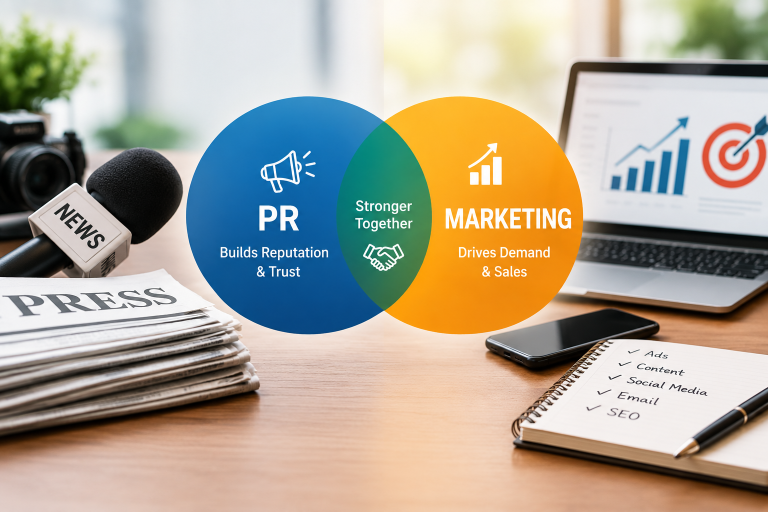
The two channels work better together than separately: PR creates attention, while SEO ensures that the destination page can satisfy the user who arrives.
Frequently Asked Questions
What does digital PR do for SEO?
Digital PR supports SEO by earning editorial backlinks, increasing relevant brand mentions, driving referral traffic, and strengthening the external credibility of a website.
What is digital PR in SEO?
Digital PR in SEO is the use of original research, expert commentary, media outreach, and newsworthy content to earn third-party coverage, links, citations, and brand references.
Are PR backlinks good for SEO?
PR backlinks can be valuable when they come from relevant, credible publications and appear naturally in editorial content. Their value depends on relevance, context, quality, and the potential to send qualified traffic.
Does digital PR directly improve Google rankings?
Digital PR can contribute to greater organic visibility, especially when it earns relevant links and increases brand recognition. However, it cannot guarantee rankings because Google evaluates many signals across a website and search result.
Do unlinked brand mentions help SEO?
Unlinked mentions can increase awareness and help associate a brand with a topic, but they do not work in the same way as hyperlinks. They should not be treated as a guaranteed substitute for relevant editorial backlinks.
Does digital PR help AI search visibility?
Digital PR may help AI search visibility by creating credible third-party references that AI systems can discover and use as sources. Results vary by platform, query, source quality, freshness, and the information available across the web. Google notes that its AI search features draw on content from the Search index. (developers.google.com)
What is the difference between digital PR and link building?
Digital PR uses newsworthy ideas, research, and expertise to earn media coverage. Link building focuses more narrowly on acquiring hyperlinks. A strong digital PR campaign can achieve both editorial coverage and high-quality backlinks.
Who offers digital PR that supports SEO growth?
Digital PR services may be offered by specialist PR agencies, SEO agencies, outreach firms, and integrated content marketing agencies. Evaluate providers by reviewing the relevance of their placements, the originality of their campaigns, their reporting methods, and whether they avoid guaranteed links or rankings.
What is the role of digital PR in SaaS SEO?
Digital PR can help SaaS brands promote original research, product innovation, customer results, expert opinions, and industry data. These campaigns may earn links to reports, tools, comparison pages, and educational resources while establishing category expertise.
How long does digital PR take to support SEO?
The timeline varies. Media coverage may appear within days or weeks, while secondary links, branded searches, referral traffic, and organic visibility may develop over several months. Results depend on the campaign, industry, publication cycle, and strength of the website.
Conclusion
Digital PR supports SEO by creating credible connections between a brand, its expertise, and trusted third-party websites. Its strongest outcomes usually come from campaigns that offer original data, useful resources, timely expertise, or genuinely newsworthy ideas.
To get started, choose one asset, define a measurable objective, identify relevant publications, and pitch a clear story. Then measure links, mentions, referral traffic, conversions, organic visibility, and AI search presence separately. This approach treats digital PR as more than a link-building tactic: it becomes a way to build lasting authority and visibility across search and the wider web.