
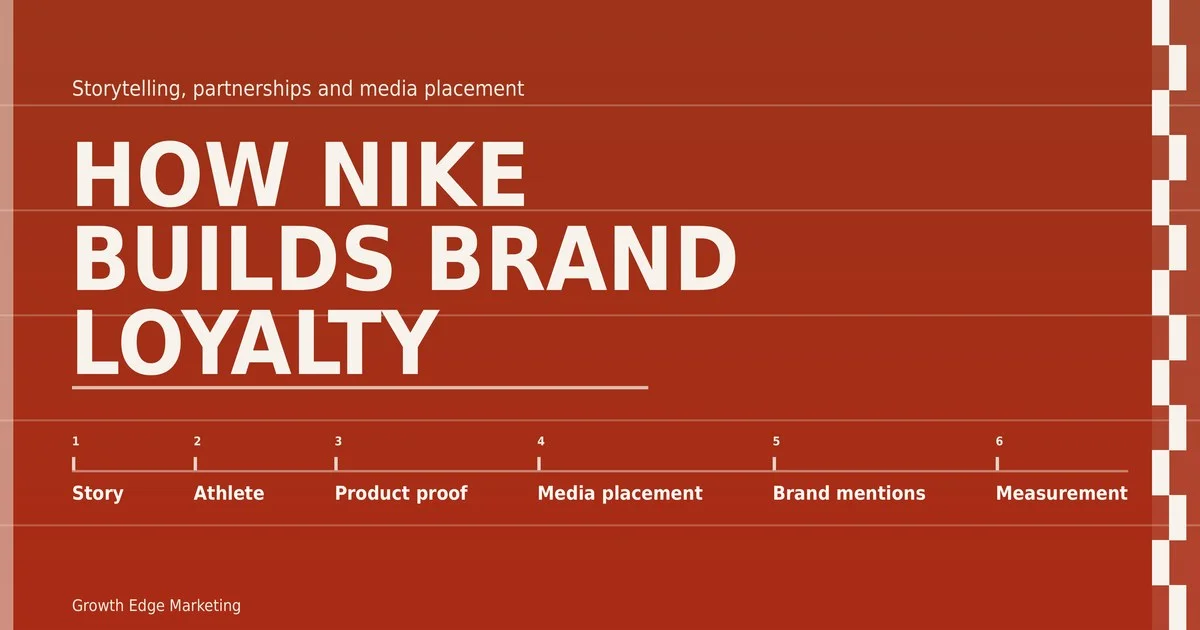

You have probably seen Nike’s advertisements, athlete partnerships, and “Just Do It” campaigns. The deeper strategy is how Nike connects those stories with product innovation, cultural conversations, media distribution, and repeated brand exposure.
This article talks about Nike’s campaigns, public financial data, and marketing methods, with limited reference to the types of visibility services Growth Edge Marketing provides.
What Is Nike’s Brand Storytelling Strategy?
Nike’s brand storytelling strategy uses athlete journeys, product innovation, cultural values, and motivational narratives to connect sport with personal identity.
Nike rarely presents its products as only shoes, clothing, or equipment. Instead, its campaigns position products within a larger story about discipline, ambition, resilience, equality, competition, or belonging.
For example, Nike’s “Dream Crazy” campaign featured Colin Kaepernick as narrator alongside athletes including Serena Williams and LeBron James. The campaign presented achievement as the result of pursuing an ambitious goal despite doubt or criticism.
This approach gives Nike several communication layers:
- The athlete provides a human story.
- The product provides a connection to performance.
- The message creates an emotional interpretation.
- The media placement expands reach.
- Public discussion creates additional brand mentions.
Nike’s fiscal 2025 annual report describes its use of athlete insights and athlete journeys as part of product innovation and storytelling. This shows that athletes are not only advertising faces; they can also inform product development and brand communication.
Nike’s own marketing leadership describes the same principle. Announcing the 2025 “So Win” anthem, Chief Marketing Officer Nicole Graham said the company keeps the athlete at the centre of everything from product creation to storytelling, and that the brand is at its best when the athlete’s voice becomes the brand’s voice.
Why Does Nike’s Storytelling Matter?
Nike’s storytelling matters because it gives consumers reasons to identify with the brand beyond product features.
A shoe can be compared by price, materials, comfort, technology, or design. A story adds another decision factor: What the brand represents and how the customer wants to see themselves.
Brand storytelling does not guarantee loyalty. However, it can strengthen memory, distinctiveness, emotional relevance, and conversation when the message is credible and consistently supported by the company’s actions.
Brand Finance reported that Nike was the strongest apparel brand globally in 2025, with a Brand Strength Index score of 94.7 out of 100. Brand strength is not identical to customer loyalty, but the result indicates that Nike continued to show strong brand perceptions in that ranking.
The distinction is important:
| Metric | What it measures | Nike example |
| Impressions | Potential exposure to a campaign | 632 million impressions in 72 hours for “You Can’t Stop Us”; more than 1.7 billion across the nine-week “So Win” campaign |
| Video views | Content consumption | More than 59 million YouTube views for “You Can’t Stop Us” |
| Share of conversation | Attention relative to competitors | 21% share of Super Bowl LIX advertising conversation for “So Win” |
| Brand strength | Perceptions such as familiarity, consideration, and reputation | Brand Finance BSI score of 94.7 in 2025 |
| Revenue | Company sales across products and markets | $46.3 billion in Nike fiscal 2025 revenue |
| Loyalty | Repeat preference, retention, advocacy, and purchasing | Not established by campaign reach alone |
How Does Nike Use Athletes as Storytellers?
Nike uses athletes as storytellers by connecting personal achievement, cultural identity, and product performance.
An athlete partnership becomes strategically valuable when the athlete contributes credibility, audience relevance, product insight, and a story that audiences recognise as authentic.
Nike has built long-term relationships with athletes across basketball, football, tennis, running, athletics, and other sports. The company’s annual report identifies athlete relationships and sports marketing as important parts of its business and demand-creation activities.
Athlete credibility
Athletes provide evidence that a product belongs in a particular performance context. A professional runner can demonstrate the relevance of running footwear, while a basketball player can make performance apparel or footwear more meaningful to basketball audiences.
This does not mean an endorsement proves that a product is objectively superior. It means the athlete gives the product a credible connection to the sport and audience.
Athlete identity
Nike’s most recognisable campaigns often make the athlete’s identity part of the narrative. Serena Williams represents excellence and resilience in tennis. Colin Kaepernick represented a values-based position that made Nike part of a wider public conversation. LeBron James represents basketball performance, leadership, and cultural influence.
More recently, Nike has built campaigns around a generation of women athletes whose individual stories were already the subject of public debate – Caitlin Clark, Sha’Carri Richardson, A’ja Wilson, Jordan Chiles, Sabrina Ionescu and Sophia Wilson among them.
The partnership becomes more memorable when the athlete’s real story and the brand’s message overlap.
Athlete product insight
Nike’s relationship with athletes also connects marketing with product development. Athletes can offer feedback on fit, movement, comfort, durability, and performance requirements.
This creates a stronger marketing foundation because the story can connect to actual product work. The best athlete campaigns are not only inspirational; they are supported by something tangible.
How Did Nike Use the Dream Crazy Campaign?
Nike used “Dream Crazy” to combine athlete storytelling, brand purpose, media placement, and public conversation.
The campaign marked the 30th anniversary of “Just Do It” and featured Colin Kaepernick as the central voice. The extended advertisement also included athletes such as Serena Williams and LeBron James.
The campaign’s message was built around pursuing a difficult goal regardless of the obstacles or criticism involved. Kaepernick’s presence made the message politically and culturally significant because of his protest against racial injustice and the reaction that followed.
Nike distributed the campaign through digital channels and major sports environments. CNBC reported that the advertisement was scheduled for exposure around NFL games, the U.S. Open, MLB games, and college football.
What did the sales data show?
Edison Trends data, reported by The Guardian, showed that Nike online sales rose 31% from Sunday through Tuesday over Labor Day in 2018, compared with a 17% increase over the comparable period in 2017.
This is a real and widely reported short-term sales comparison. It should not be overstated.
The data does not prove that the campaign caused long-term loyalty, increased customer lifetime value, or permanently improved Nike’s market position. It shows that online sales performed strongly during the measured period after the campaign launched.
The campaign also created extensive public discussion. That discussion included support, criticism, calls for boycotts, news coverage, and analysis of Nike’s business decision. From a brand-visibility perspective, the campaign produced more than paid exposure; it became a subject that other people discussed.
How Does Nike Use Media Placement?
Nike uses media placement to distribute its stories through channels connected to sports, culture, entertainment, retail, and digital content.
Media placement includes more than buying advertising space. It can involve:
- Sports broadcasts.
- Digital video platforms.
- Social-media distribution.
- Publisher partnerships.
- Event-related exposure.
- Retail environments.
- Athlete and creator channels.
- Earned media coverage.
- Nike-owned websites and apps.
The “Dream Crazy” campaign shows how Nike matched a message about athletes and sports with sports-media environments. This kind of contextual placement helps the audience understand why the story is relevant.
Nike’s demand-creation expense includes brand marketing and sports marketing. The company defines brand marketing expense as including advertising and promotion costs such as production, media, digital marketing, brand events, and retail brand presentation. Sports marketing includes endorsement contracts, complimentary products, and sports marketing events.
In fiscal 2025, Nike reported demand-creation expense of $4.7 billion, up 9% year on year, driven by higher brand marketing and higher sports marketing spend.
That number shows the scale of Nike’s marketing and sports-investment system. It does not mean that every dollar directly produced a measurable sale.
How Did Nike Use the You Can’t Stop Us Campaign?
Nike used “You Can’t Stop Us” to turn a social message about connection into a visually distinctive media campaign.
The 2020 campaign used a split-screen film that matched athletes performing similar movements. One athlete’s action appeared to continue into another athlete’s footage, creating the impression of one connected sporting performance.
WARC reported that the campaign was created to build awareness and excitement around the return of the NBA during the pandemic period. It also reported 632 million global impressions in the first 72 hours and more than 59 million YouTube views.
The campaign worked through four connected mechanisms:
- A simple idea: Sport can connect people even when physical spaces are divided.
- A distinctive execution: Split-screen editing made the message visible rather than merely verbal.
- Athlete participation: Recognisable sporting figures provided energy and credibility.
- Multi-channel distribution: Digital video and social sharing allowed rapid international reach.
The campaign’s performance demonstrates the value of a strong creative idea supported by media distribution. The numbers measure exposure and content consumption, not customer loyalty by themselves.
How Did Nike Use the So Win Campaign?
Nike used “So Win” to combine a single high-attention media placement with a nine-week distribution plan and a wider commercial strategy aimed at women.
The 60-second anthem, created by Wieden+Kennedy Portland and directed by Kim Gehrig, ran during Super Bowl LIX in February 2025 and was narrated by the musician Doechii. It featured Sabrina Ionescu, Jordan Chiles, Caitlin Clark, Sha’Carri Richardson, A’ja Wilson and Sophia Wilson, and addressed the criticism that women athletes face for the confidence and competitiveness their sports demand. Alongside the film, Nike released athlete extensions, still photography and a social campaign.
The placement itself was part of the story. It was Nike’s first Super Bowl advertisement in 27 years, which made the media buy newsworthy before anyone had seen the creative.
What the campaign reported?
Campaign documentation submitted to the Shorty Awards reports that the Super Bowl LIX broadcast reached 131.1 million viewers; that Nike captured 21% of Super Bowl advertising conversation across 66 advertisers and generated more than 1,400 news mentions; that featured athletes saw a tenfold lift in online mentions in the days after the broadcast; and that the full nine-week campaign delivered more than 1.7 billion impressions.
The advertisement also won the Super Clio for the most creative spot of Super Bowl LIX.
Two caveats matter here. First, awards-entry figures are supplied by the agency and brand rather than independently audited, so they should be described as reported rather than verified. Second, “So Win” ran during a year in which Nike’s revenue declined, which is a useful reminder that a campaign can perform well on attention metrics while the wider business is working through a turnaround.
How Do Nike’s Partnerships Support Brand Growth?
Nike uses partnerships to gain credibility, cultural relevance, product insight, and access to communities.
These partnerships include:
- Athletes.
- Sports teams.
- Leagues and sporting events.
- Universities.
- Retailers.
- Designers and cultural figures.
- Community organisations.
- Creative agencies.
- Technology and product-development partners.
A partnership is more valuable when it adds something the brand cannot create alone. An athlete can provide expertise and credibility. A university can provide community access. A major sports event can provide concentrated attention. A creative partner can provide a new visual language.
A current example: NikeSKIMS
In February 2025, Nike announced NikeSKIMS, a joint women’s activewear brand with Kim Kardashian’s SKIMS. Reporting at the time noted this was the first occasion Nike had partnered with an outside company to create a new brand, and Nike’s share price rose 6.2% on the announcement, adding roughly $6.7 billion in market value.
The first collection launched on 26 September 2025 after production delays pushed it back from spring, with three core collections plus seasonal ranges, and a global rollout planned for 2026. CNBC reported the partnership as part of Nike’s strategy to recover share among women shoppers from brands such as Lululemon, Vuori and Alo Yoga.
NikeSKIMS illustrates all three partnership mechanisms below at once: SKIMS brought a distinct audience and design point of view, the launch generated substantial earned coverage, and the delay itself became a widely reported story – a reminder that partnership visibility cuts both ways.
Partnerships can support growth in three ways:
1. Credibility transfer
The partner’s reputation can make the brand more relevant to a specific audience. A running partnership can make Nike more visible among runners, while a basketball partnership can deepen connection with basketball communities.
2. Content creation
Partners provide stories, images, interviews, events, and experiences that can be distributed across media. This creates more opportunities for press coverage, sponsored content, and brand mentions.
3. Community access
A partnership can connect Nike to communities that may be difficult to reach through broad advertising alone. Local events, teams, athletes, and universities can create repeated contact between the brand and its audience.
Nike’s newsroom publishes partnership announcements on an ongoing basis, including collegiate agreements.

How Does Nike Build Brand Mentions?
Nike builds brand mentions through campaigns that give publications, athletes, creators, sports organisations, and consumers reasons to discuss the brand.
A strategic brand mention is not simply the appearance of a company name. It is a relevant reference that adds context, connects to a current topic, or helps an audience understand a product, campaign, partnership, or position.
Nike’s “Dream Crazy” campaign generated mentions around:
- Colin Kaepernick.
- The “Just Do It” anniversary.
- Athlete achievement.
- Social issues.
- Consumer reactions.
- Advertising strategy.
- Nike’s commercial performance.
The “You Can’t Stop Us” campaign generated discussion around:
- The return of sport during the pandemic.
- The campaign’s split-screen production.
- Athlete participation.
- Social connection.
- Campaign reach.
- Nike’s creative strategy.
“So Win” generated discussion around:
- Nike’s return to the Super Bowl after 27 years.
- The treatment of women athletes in public commentary.
- The individual athletes featured.
- Doechii’s narration and the black-and-white direction.
- Advertising-industry judgement, including the Super Clio award.
- Nike’s turnaround under CEO Elliott Hill.
This is why campaign design matters. A product announcement may create one news angle. A campaign connected to sport, culture, people, and public discussion can create several.
Growth Edge Marketing provides strategic brand mentions and media services comparable to some of these visibility activities. Nike is not a Growth Edge client, and the relevant point here is the marketing method rather than any client relationship.
How Does Nike Measure Marketing and Brand Growth?
Nike measures marketing within a broader business system that includes revenue, digital sales, retail performance, product demand, sports marketing, brand activity, and customer engagement.
Nike reported fiscal 2025 revenue of $46.3 billion, compared with $51.4 billion in fiscal 2024. NIKE Direct revenues declined 13% to $18.8 billion, and gross margin decreased 190 basis points to 42.7%.
These figures should be read in context. Nike’s revenue includes global markets, multiple product categories, wholesale operations, NIKE Direct, and many marketing activities. It would be inaccurate to attribute the entire result to digital PR, media placement, sponsored content, or brand mentions.
A responsible campaign measurement framework separates the following:
- Visibility: Impressions, reach, views, and media placements.
- Engagement: Comments, shares, watch time, and interaction quality.
- Interest: Branded search activity, website visits, product-page views, and email sign-ups.
- Commercial action: Purchases, qualified leads, and assisted conversions.
- Loyalty: Repeat purchases, retention, advocacy, membership activity, and customer lifetime value.
This separation protects against a common marketing error: Treating exposure as proof of loyalty.
How Can Growing Brands Learn From Nike?
Growing brands can learn from Nike by adapting the structure of its campaigns rather than copying its budget, athletes, or global reach.
1. Start with a real belief
Nike’s strongest campaigns communicate a clear idea about sport, effort, identity, or possibility. A smaller brand should identify a belief it can support through its products and actions.
2. Use a credible storyteller
The storyteller may be an athlete, customer, founder, coach, designer, engineer, or community leader. The person should have a genuine connection to the subject.
3. Create evidence
A message becomes stronger when it is supported by a product improvement, customer result, event, partnership, research finding, or community action.
4. Build one central narrative
The same campaign idea can be adapted into a press pitch, sponsored article, video, social post, event, brand mention, and community discussion. Each version should fit its channel. “So Win” is a compact example: one 60-second film, then athlete-specific cutdowns, stills, and a social campaign sustained over nine weeks.
5. Choose relevant media
A specialist publication with the right audience may deliver more value than a large but unrelated website. Growth Edge’s services focus on digital PR, media placement, sponsored content, press distribution, and brand mentions for growing brands.
6. Measure beyond reach
Track visibility and business outcomes separately. A campaign should report placements and impressions, but also referral traffic, qualified inquiries, conversions, repeat activity, and customer feedback where available.
Which Tools Support These Marketing Activities?
Nike operates at a scale that requires large internal and external marketing systems. Smaller brands can use tools to support research, outreach, monitoring, and reporting.
- Muck Rack: Journalist research, media monitoring, and relationship management.
- BuzzStream: Outreach organisation, contact records, and campaign follow-up.
- Pitchbox: Structured prospecting and outreach workflows.
- Google Trends: Changes in search interest around a campaign or brand.
- Google Search Console: Branded search queries and organic visibility.
- Google Analytics 4: Referral traffic and conversions from campaign placements.
- Social listening tools: Public discussion, sentiment signals, and recurring themes.
Tools do not create a compelling campaign by themselves. They help a team find relevant media, monitor conversations, organise outreach, and measure results.
What’s Next for Nike’s Brand Strategy?
Nike’s future brand strategy depends on whether it can continue connecting strong product performance with culturally relevant storytelling and credible partnerships.
Nike’s fiscal 2025 reporting described a focus on returning to sport, investing in key sports moments, launching products, strengthening local relationships, and improving marketplace execution.
There are early signs that the approach is producing results. In fiscal 2026 second-quarter results covering the quarter ended 30 November 2025, Nike reported revenues of $12.4 billion, up 1% on a reported basis, with wholesale revenues up 8%. Demand-creation expense rose 13% to $1.3 billion on higher brand and sports marketing. CEO Elliott Hill described the company as being in the middle innings of its comeback under a “Win Now” plan.
The challenge is that strong brand history does not guarantee permanent growth. Nike reported lower fiscal 2025 revenue than fiscal 2024 despite continued investment in demand creation, and gross margin remained under pressure into fiscal 2026.
That makes the next phase especially important. Nike must continue to make its stories relevant while ensuring that products, partnerships, retail experiences, and customer relationships support those stories.
Conclusion
Nike strengthens brand loyalty by connecting five activities: Meaningful storytelling, credible partnerships, relevant media placement, repeated brand mentions, and products that support the promise being communicated.
“Dream Crazy” showed how an athlete-led cultural message could create attention, discussion, and short-term sales momentum. “You Can’t Stop Us” showed how a distinctive creative idea could generate global reach during an unusual period for sport. “So Win” showed how a single high-attention placement can be extended into a sustained multi-week campaign. Nike’s fiscal reports show the scale of the company’s investment in brand and sports marketing, while its newsroom demonstrates how it controls and distributes official company information.
The main lesson is not that every brand should imitate Nike’s campaigns. The lesson is that visibility works best when the story is credible, the partner is relevant, the media environment fits the audience, and the results are measured honestly.

